Blog - Published: Thursday, 2026-07-09 12:00 UTC
Orchestration is where agents become systems.
A single AI assistant can answer a question. An orchestrated agent system can plan a task, retrieve context, call tools, assign specialist work, evaluate the result, retry intelligently, preserve state, and decide when human attention is actually needed.
That distinction matters for IntelliOS. A cyber intelligence platform does not only need AI-generated text. It needs source monitoring, report ingestion, retrieval, drafting, quality checks, alerting, page updates, regression tests, model routing, and release discipline working together.
Classical AI
Agents started as goal-directed systems
Before modern LLMs, agent systems were framed around goals, state, actions, planning, environments, and feedback. The central question was how a system could perceive, decide, act, and adapt.
2022
MRKL pushed modular AI systems
MRKL systems argued for combining language models with external knowledge sources and discrete reasoning modules. That is an early blueprint for orchestration: route work to the right capability instead of expecting one model to do everything.
2022
ReAct connected reasoning and action
ReAct showed how language models could interleave reasoning traces with task-specific actions, such as querying an external source and updating the plan from the observation.
2023
Toolformer made tool use explicit
Toolformer explored models deciding when to call APIs, which arguments to pass, and how to incorporate tool results. That helped popularize the idea that a model could be part planner and part tool user.
2024 and after
MCP and agent SDKs made orchestration product infrastructure
MCP standardized connections to external tools and data, while modern agent SDKs made turns, tools, guardrails, handoffs, sessions, and state management first-class application concerns.
The orchestration loop
Agent orchestration is a control loop. The system sets a goal, gathers context, plans steps, selects tools, acts, observes the result, evaluates quality, retries or hands off, persists state, and reports the outcome.
The more autonomous the system becomes, the more important that loop becomes. Autonomy should not mean hidden behavior. It should mean visible goals, visible constraints, visible traces, and fewer routine human clicks.
Set goal
Gather context
Plan steps
Select tools
Execute action
Observe result
Evaluate quality
Retry or hand off
Persist state
Report outcome
Core orchestration concepts
Planner
Breaks a goal into steps, chooses an approach, decides whether more context is needed, and updates the plan when observations change.
Tool router
Chooses among APIs, retrieval systems, MCP servers, local tools, browser checks, database lookups, model calls, and human approval queues.
Specialist agents
Divide work by role: research, retrieval, drafting, publication, QA, monitoring, alerting, evaluation, and operations.
Memory and state
Tracks prior decisions, run state, source status, known failures, user preferences, evaluation results, and what has already been published.
Guardrails
Constrain autonomy with tool allowlists, schema checks, policy rules, citation requirements, budget limits, and approval gates.
Handoffs
Move work between agents or from agent to human when the task changes shape, confidence is low, or the action becomes higher impact.
Evaluation
Measures whether agents found the right source, cited evidence, avoided duplication, met quality bars, and completed the workflow.
Observability
Records traces, costs, model choices, failures, retries, latency, tool calls, and output quality so the system can be improved over time.
How IntelliOS uses orchestration today
IntelliOS already has orchestration-shaped pieces: agent categories, monitored sources, generated products, alert workflows, retrieval and citation controls, model routing, usage ledgers, regression harnesses, and browser verification. Some are fully implemented; others are prototype or roadmap pieces.
The important learning is architectural: agents should not be personality wrappers. They should be goal-conditioned workers with inputs, tools, state, decision gates, output contracts, traces, and quality bars.
Autonomy boundary
The goal is less routine intervention, not blind automation. High-impact publishing, customer notification, credentialed tool use, billing-affecting choices, and destructive changes should keep explicit approval until the control layer is mature.
FORGE agent registry
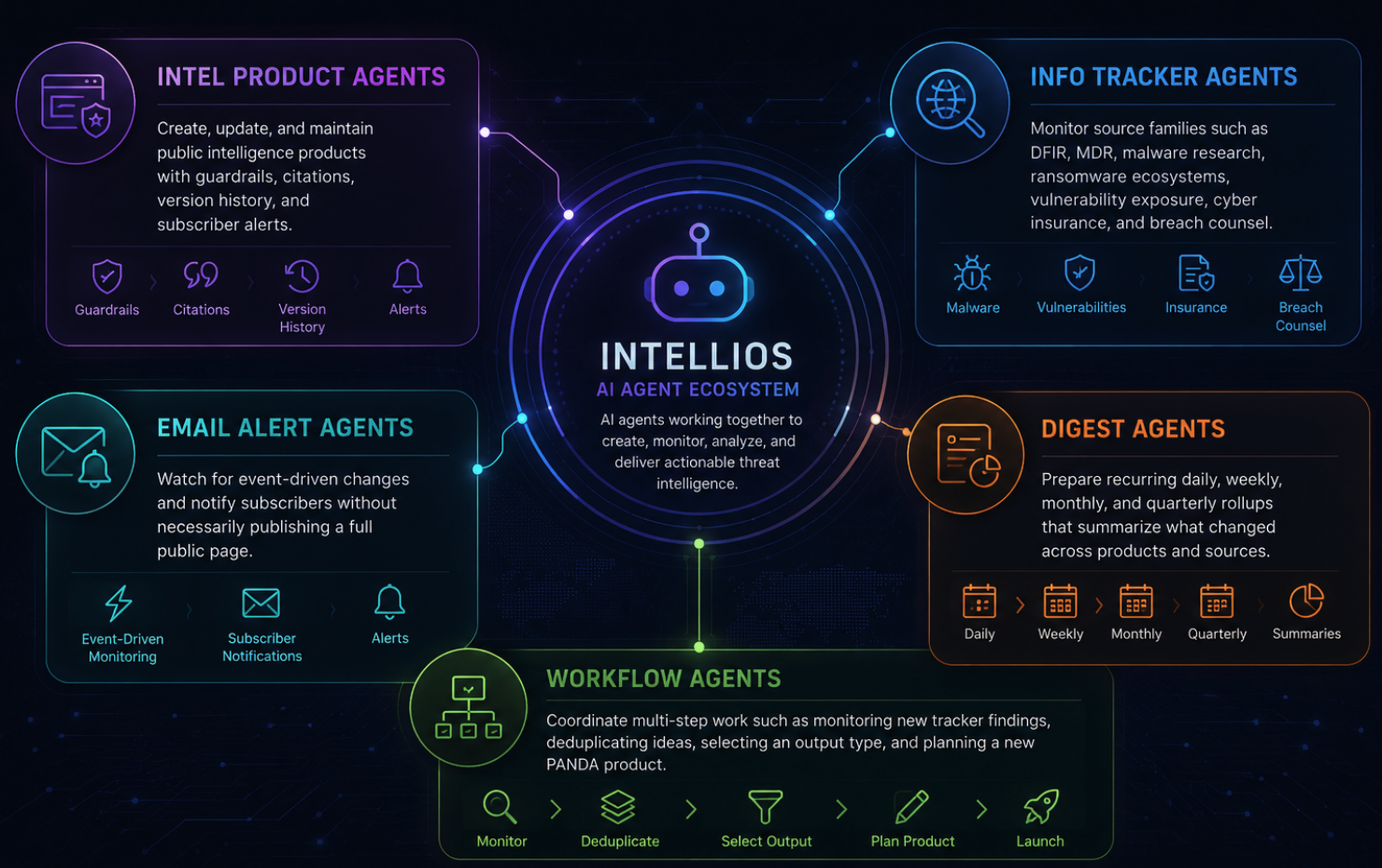
IntelliOS already separates agent categories such as intel product agents, info tracker agents, email alert agents, digest agents, and workflow agents. That is an orchestration pattern because the platform distinguishes what kind of output an agent owns and what actions it can take.
Source monitoring workflows
Monitoring logic watches source families, detects candidate changes, compares evidence, suppresses noise, and routes meaningful updates toward pages, alerts, or review.
Grounded generation flows
Chat and intelligence outputs use retrieval, selected report context, citation rules, model routing, and response validation instead of letting a model answer from memory alone.
Alert and subscription runs
AI-generated updates are not just text. They pass through subscription preferences, notification logic, run logs, delivery paths, and human-facing constraints.
Quality harnesses
The codebase includes evaluation and regression scripts for chat, agent quality, PANDA output, query flows, source monitoring, and threat actor cards. These harnesses are the beginning of agent quality management.
AI-assisted build loop
Building IntelliOS with an AI coding agent demonstrated orchestration in practice: inspect files, plan changes, edit code, run typechecks, use browser verification, read failures, and iterate.
Autonomy ladder for IntelliOS
Level 1
Observe
Agent watches sources, logs changes, and summarizes evidence without changing public output.
Level 2
Draft
Agent prepares a proposed update, article, alert, or fix for human review.
Level 3
Recommend
Agent ranks options, explains tradeoffs, and suggests the next best action with supporting evidence.
Level 4
Execute reversible tasks
Agent updates low-risk state, runs checks, opens drafts, refreshes metadata, or prepares staged artifacts.
Level 5
Publish bounded changes
Agent publishes pre-approved categories of updates under strict source, quality, and rollback rules.
Level 6
Manage workflows
Agent coordinates other agents, budgets, queues, evaluation, and quality recovery with exception-based human involvement.
Future ideas to explore
IntelliOS evolution planner
A platform-level planning agent could read product goals, backlog notes, telemetry, failed checks, and user behavior to propose the next set of improvements.
Less human intervention: Human role shifts from writing every task to approving higher-level direction, budget, and release boundaries.
Autonomous content expansion agent
An agent could identify missing newsroom topics, source trackers, threat actor profiles, CVE briefs, and explainers, then draft pages with citations and visual QA.
Less human intervention: Humans review only new topic strategy or high-impact claims instead of manually creating every draft.
Agent performance manager
A supervisor agent could monitor latency, cost, failure rate, citation quality, duplicate rate, freshness, and user-facing quality across other agents.
Less human intervention: Routine tuning recommendations and regression triage become automated; humans handle policy decisions and major model-routing changes.
Quality recovery agent
When a harness fails, an agent could inspect the failing output, locate likely causes, propose a patch, run typecheck and browser verification, and prepare a review note.
Less human intervention: Human involvement moves from diagnosis to reviewing a concrete fix with evidence.
Retrieval curator agent
A specialist agent could find low-quality chunks, stale citations, source collisions, duplicate reports, and weak evidence packets, then prepare cleanup actions.
Less human intervention: Humans approve corpus policy while routine source hygiene runs continuously.
Release captain agent
A release agent could coordinate checks, screenshots, known risks, changelog entries, deployment readiness, and rollback notes before a production push.
Less human intervention: Humans make the final release call while the agent owns the checklist and evidence pack.
Agent budget allocator
A budget-aware orchestrator could choose models, retry limits, retrieval depth, and run schedules based on task priority and expected value.
Less human intervention: Humans set spending guardrails; the system optimizes routine model and workflow choices.
Exception-based oversight
The platform can gradually move from reviewing every action to reviewing exceptions: low confidence, high impact, policy conflict, unusual cost, or failed evaluation.
Less human intervention: Human attention is reserved for the moments where judgment matters most.
What truly autonomous planning could mean
A more autonomous IntelliOS agent would not simply write whatever it wants. It would maintain a platform map: current products, source coverage, quality scores, broken workflows, gaps in the corpus, upcoming risks, technical debt, and user-facing opportunities.
From that map, it could propose a plan, assign work to specialist agents, run checks, stage changes, compare results against quality bars, and ask for review only when a decision crosses a defined risk boundary.
What agent quality management could mean
Agent quality management is the next step after agent creation. It means measuring whether each agent is accurate, source-backed, cost-aware, timely, non-duplicative, and aligned with the product's decision logic.
A supervisor agent could review the other agents' runs, find weak outputs, trigger regression harnesses, recommend model-route changes, tune retrieval scope, and retire stale automation paths before humans notice drift.
Design risks to manage
Runaway autonomy
A planning agent can keep acting even when the goal is stale, the evidence is weak, or the cost is rising. Autonomy needs budgets, stop conditions, and escalation rules.
Agent-to-agent drift
Specialist agents can optimize local goals while the platform loses coherence. A supervisor needs shared quality standards, product strategy, and trace visibility.
Quality theater
An agent can produce logs and checklists without actually improving output quality. Evaluation must test real outcomes, not just activity.
Over-publishing
Content agents can produce more pages than the system can maintain. Orchestration should include freshness, retirement, dedupe, and source-quality controls.
Hidden cost and latency
Multi-agent systems can multiply model calls quickly. Good orchestration includes routing, caching, retrieval limits, and cost-aware planning.
Weak rollback paths
More autonomous action requires better undo, versioning, staged publication, audit trails, and release gates.
The takeaway from building IntelliOS
Agent orchestration is the path from AI assistance to AI operations. It lets a platform coordinate goals, tools, memory, specialist agents, checks, and handoffs so routine work can run with less direct human involvement.
For IntelliOS, that means moving toward agents that do more than generate content: agents that monitor the platform, identify gaps, propose improvements, manage source freshness, test other agents, prepare releases, and keep the system improving under clear autonomy boundaries.