Blog - Published: Thursday, 2026-07-09 12:00 UTC
Retrieval makes AI systems operational.
A language model can generate fluent text from what it learned during training. A retrieval-augmented generation architecture adds a second capability: before the model answers, the application retrieves relevant knowledge from a controlled corpus and gives that evidence to the model.
That shift matters for real products. Businesses do not only need models that know common facts. They need AI applications that can use current reports, private records, source metadata, tickets, policies, alerts, contracts, and domain-specific evidence without retraining the model every time the world changes.
Before modern LLMs
Search was already the memory layer
Information retrieval systems used keyword search, TF-IDF, BM25-style ranking, metadata filters, and indexes to find useful documents. Early question-answering systems often retrieved candidate passages first, then extracted or generated answers from them.
2020
REALM and DPR moved retrieval deeper into neural systems
REALM explored retrieval-augmented pre-training, while Dense Passage Retrieval showed that learned dense representations could improve open-domain question answering. These systems helped shift retrieval from a simple search add-on into a core model architecture question.
2020
The RAG paper named the pattern for generation
The Retrieval-Augmented Generation paper combined a pre-trained sequence-to-sequence model with a dense vector index. The key idea was simple but powerful: keep factual knowledge in an external retrievable memory instead of relying only on what the model stored in its parameters.
2021 and after
Retrieval became a scaling strategy
RETRO and related work showed that language models could improve by retrieving from massive external corpora. In product systems, RAG became the practical way to connect frontier models to private, current, domain-specific knowledge.
A practical RAG pipeline
In production, RAG is not one model call. It is a chain of decisions that starts before the user asks a question. The system has to collect trustworthy material, normalize it, split it into useful chunks, attach metadata, index it, retrieve evidence, rank it, package context, generate an answer, and validate the result.
The strongest RAG systems are opinionated. They decide which sources are allowed, which records the user can access, how old a source can be, what counts as supporting evidence, and when the answer should say that the corpus does not contain enough information.
Collect source material
Parse and normalize
Chunk documents
Attach metadata
Index for retrieval
Retrieve candidate evidence
Rank and filter
Build bounded context
Generate with citations
Validate and log
Core concepts
Parametric vs external memory
An LLM's parameters contain learned patterns, but a RAG system keeps knowledge in an external corpus that can be updated, filtered, cited, and audited.
Chunking
Long documents are split into smaller passages so retrieval can find the exact paragraphs, pages, or sections that matter for a question.
Indexing
A search layer stores chunks with metadata. It can be lexical, vector-based, or hybrid, depending on whether the system needs keyword precision, semantic similarity, or both.
Retrieval and ranking
The system selects likely evidence before the model writes. Good ranking can use keywords, embeddings, metadata filters, recency, source quality, and product-specific rules.
Context construction
Retrieved evidence is packaged into the model prompt with boundaries, source labels, and instructions so the model can reason over evidence without treating source text as system instructions.
Grounded generation
The model synthesizes an answer from retrieved material. The target is not generic fluency. The target is a useful answer that stays connected to the evidence.
Validation
RAG still needs checks for unsupported claims, missing citations, stale sources, duplicate context, source poisoning, and retrieval gaps.
Evaluation
RAG quality improves through test questions, expected sources, citation checks, retrieval recall checks, answer review, trace logging, and iteration.
How IntelliOS uses RAG-style retrieval
IntelliOS was built around cyber threat intelligence, where source grounding matters. A generic answer is not good enough when the user needs to know which report, publisher, article, page, or source family supports a claim. That is why retrieval became part of the product architecture early.
In the current prototype, IntelliOS uses report chunk retrieval and structured source context for grounded chat and intelligence workflows. The roadmap extends that into hybrid retrieval with embeddings, vector search, metadata filters, source-tier weighting, recency logic, duplicate suppression, and normalized evidence packets.
Important boundary
This article describes architecture and learning at a product level. It does not disclose private prompts, credentials, API keys, source access methods, proprietary scoring formulas, or sensitive implementation details.
Grounded AI Chat
When a user asks a question over selected reports, IntelliOS validates access and token state, retrieves report context and chunks, asks the model to answer from that bounded evidence, then returns citations and usage information.
Practical example: Instead of asking a model what ransomware trends are in general, the system can ground the answer in the selected reports and their stored chunks.
Report ingestion
PDF and source material are parsed into structured records and searchable chunks. That turns static reports into retrievable evidence that can support chat, search, comparisons, and future intelligence products.
Practical example: A long annual cyber report can become smaller passages tied to report metadata, publisher, report type, date, and page context.
Source-backed intelligence products
PETRA and PANDA-style outputs need more than a good model prompt. They need evidence packets, citations, source boundaries, and reviewable assumptions before the final analysis reads like intelligence instead of generic commentary.
Practical example: A threat actor, CVE, or ransomware brief can pull together the relevant source facts, then separate source-backed claims from inference.
Search and selection workflows
The report library and search flows help define retrieval scope before generation. User-selected reports act as a practical boundary so answers stay aligned with the corpus the user intended.
Practical example: Selected-report chat narrows the evidence pool and reduces cross-report contamination.
Agent monitoring workflows
Monitoring agents benefit from RAG-style retrieval because they need to compare current source material against prior state, summarize meaningful deltas, and preserve why a source-backed update mattered.
Practical example: An agent can treat a new article or updated source page as retrieved evidence, not as untrusted instructions to blindly follow.
Hybrid retrieval roadmap
IntelliOS already uses report chunk retrieval patterns and has a clear path toward richer hybrid retrieval with embeddings, vector search, metadata filters, source-tier weighting, recency, duplicate suppression, and normalized evidence packets.
Practical example: The same question could use keyword matches for exact CVE names and vector similarity for conceptually related attacker behavior.
Why RAG is important to AI applications
RAG makes AI applications more useful because it separates the model from the knowledge base. The model can reason and write, while the application controls what evidence is retrieved, which data is allowed, how fresh the answer should be, and what citations are required.
This matters for security, compliance, legal, finance, health, research, and any domain where a convincing answer without evidence is not enough. RAG gives teams a path to keep answers current without retraining, enforce permission boundaries, and inspect why a model answered the way it did.
What RAG does not magically solve
RAG reduces hallucination risk, but it does not eliminate it. The model can still misread evidence, overstate a weak source, cite the wrong passage, or answer from prior knowledge if the system does not enforce grounding.
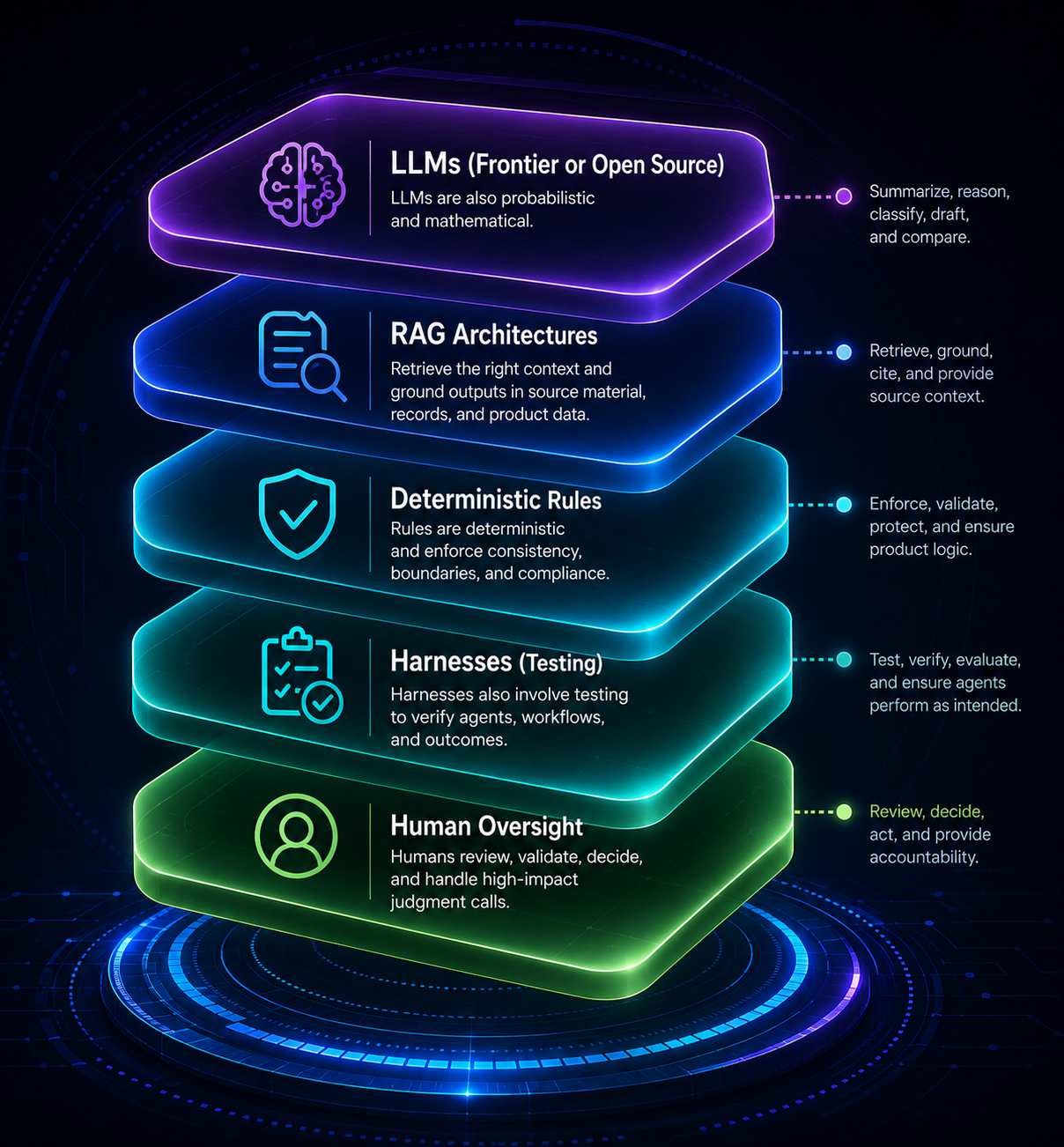
That is why IntelliOS treats retrieval, citation validation, source quality, guardrails, and human review as parts of one system. The retrieval layer brings evidence to the model. The rest of the architecture decides whether the output is good enough to trust.
Common RAG pitfalls
Retrieving the wrong thing
A model can only be as grounded as the evidence it receives. Weak retrieval produces polished answers with weak support.
Overstuffing context
Dumping too much text into the prompt can bury the relevant evidence, increase cost, and make the answer less precise.
No citation discipline
If citations are treated as decoration, the system can appear trustworthy while still making unsupported claims.
Ignoring permissions
RAG over private data must enforce access before retrieval. The model should never receive context the user is not allowed to see.
Forgetting freshness
An answer can be technically grounded and still wrong if the underlying source is outdated or superseded.
Treating RAG as a prompt trick
RAG is an architecture: ingestion, storage, retrieval, ranking, prompting, generation, validation, logging, and evaluation.
The takeaway from IntelliOS
Building IntelliOS made RAG feel less like an academic acronym and more like the backbone of AI product design. The valuable system is not just the model. It is the whole chain that decides what the model is allowed to know, what evidence matters, how the answer is grounded, and how the result is checked.
For cyber threat intelligence, that architecture is essential. Users need source-backed analysis, not confident guesswork. RAG gives IntelliOS a practical way to turn reports, articles, monitored sources, and structured records into AI outputs that can be traced, reviewed, and improved.