 IntelliOSPANDAModule|AITool / Campaign Snapshot
Kali365
A Deeper Look at the PhaaS Platform
Research Framing
| Field | Value | |||||||||||||||||||||||||||||||||||||||||||||||||||||||
|---|---|---|---|---|---|---|---|---|---|---|---|---|---|---|---|---|---|---|---|---|---|---|---|---|---|---|---|---|---|---|---|---|---|---|---|---|---|---|---|---|---|---|---|---|---|---|---|---|---|---|---|---|---|---|---|---|
| Decision Question | What does the public evidence establish about Kali365 as a Microsoft 365 OAuth device-code phishing service, and how should defenders scope and contain suspected use? | |||||||||||||||||||||||||||||||||||||||||||||||||||||||
| Interpreted Questions | What is Kali365? How does the device-code flow produce token or session access? What campaign tooling is publicly supported? Which signs should responders preserve? What is confirmed about operators, victims, acquisition, infrastructure, and attribution, and what remains unknown? | |||||||||||||||||||||||||||||||||||||||||||||||||||||||
| Initial Observations | Retained sources support Kali365 as an emerging Microsoft 365 phishing service centered on OAuth device-code abuse, token capture, templates, dashboards, and campaign tooling. They do not support a confirmed operator identity, named-victim list, complete panel inventory, acquisition path, or stable Kali365 IOC set. | |||||||||||||||||||||||||||||||||||||||||||||||||||||||
| Evidence Hierarchy | Tier 0 government, platform-owner, and primary technical material controls confirmed mechanics and response guidance. Technical research may expand supported tooling and detection context; news, community, discovery, and expansion sources cannot independently establish attribution, victimology, prevalence, or infrastructure ownership. | |||||||||||||||||||||||||||||||||||||||||||||||||||||||
| Tier 0 Through Tier 8 Coverage |
| |||||||||||||||||||||||||||||||||||||||||||||||||||||||
| Fact / Analysis / Unknown Boundaries | Fact: the retained record supports the described device-code and token-access behaviors and defensive actions. Analysis: the snapshot organizes those behaviors as a tool and campaign profile for incident response. Unknown: operator identity, named victims, complete infrastructure, acquisition path, pricing, and stable indicators remain unconfirmed unless a cited source expressly establishes them. |
Kali365 Campaign / Tool Snapshot
| Field | Snapshot Value |
|---|---|
| Type | Phishing-as-a-Service platform / tool ecosystem |
| Status | Emerging, publicly warned by IC3; not a single named threat actor group or one campaign. |
| First Seen | IC3 states Kali365 was first observed in April 2026. 1 |
| Distribution | Reported primarily through Telegram-linked subscription or panel access and attacker-facing infrastructure; this page intentionally avoids seller handles, channel names, payment instructions, panel URLs, and acquisition details. 1, 4, 16, 17 |
| Core Capability | Device-code lures, OAuth/access-token capture, Microsoft 365 account access, AI lures, templates, dashboards, and automation. 1, 4, 15, 16, 17 |
| Who Built / Runs It | Unknown from the public sources used here. IC3 and retained public reporting describe Kali365 as a PhaaS platform or service ecosystem, but they do not identify a confirmed developer, administrator, operator identity, real-world person, company, or named threat group behind it. 1, 15, 16, 17 |
| Kali Linux Affiliation | No source used in this snapshot establishes any affiliation between Kali365 and Kali Linux, Offensive Security, or the Kali Linux penetration-testing distribution. Treat the shared word "Kali" as a name-collision risk, not evidence of connection. 1, 23 |
| Known Victims | No named victim organizations are published in this snapshot. Victimology remains category-level: Microsoft 365 users and organizations. |
| Campaign vs Tool | Kali365 is best treated as a tool/service platform sold to or used by multiple criminal operators, not as the exclusive name of one intrusion campaign or one attributed actor. |
| Likely User Ecosystem | Public sources do not identify specific users, but the service model fits lower-to-mid level operators, BEC crews, initial-access brokers, and cybercriminals seeking Microsoft 365 account access. |
| Attribution Boundary | The sources used here do not attribute Kali365 exclusively to FIN7, Scattered Spider, a Microsoft Storm cluster, or any other named threat group. |
1-Topic
This snapshot profiles Kali365 as a Microsoft 365-focused phishing-as-a-service ecosystem that packages OAuth device-code abuse, token capture, lures, templates, dashboards, and campaign tooling for criminal operators. 1, 4, 15, 16, 17
The core defensive question is whether a user was induced to enter an attacker-supplied code into Microsoft's legitimate verification flow, producing token/session or OAuth artifacts that can survive ordinary password-reset playbooks. 1, 5, 6, 18
2-Persona / Audience Lens
| Audience | What This Snapshot Should Help Them Do | Best Use |
|---|---|---|
| Executives / Risk Leaders | Understand why Kali365 is primarily a Microsoft 365 account-takeover and BEC-investigation risk, not simply another phishing email. | Decide whether to brief users, fund scoping, and prioritize identity controls. |
| SOC / IR Teams | Identify device-code abuse, preserve evidence, hunt token/session activity, and scope Microsoft 365 resource access in BEC or cloud-account-takeover investigations. | Run investigation and containment without relying on password reset alone. |
| IAM / M365 Administrators | Translate the threat into Entra ID, OAuth consent, Conditional Access, session, and application-governance controls. | Tighten authentication-flow policy and revoke suspicious access artifacts. |
| Counsel / Claims / Client Advisors | Frame Kali365 primarily as BEC-adjacent Microsoft 365 account takeover and cloud-data exposure; ransomware is a downstream or larger-incident question only when local evidence supports it. | Support scoping calls, privilege-aware communications, and client triage. |
3-BLUF
- Kali365 is best treated as a PhaaS platform/tool ecosystem, not a single named threat actor group or one campaign. 1, 15, 16, 17
- Its significance is the packaging of Microsoft 365 OAuth device-code abuse into a subscription-style service with lures, templates, dashboards, and automation. 1, 4, 15, 16
- The attacker abuses trust in Microsoft's legitimate verification flow by supplying the code and controlling the authorization context. 1, 5, 18
- Defense requires token/session revocation, OAuth consent review, Conditional Access controls, and post-authentication Microsoft 365 access scoping; password reset alone is not enough. 1, 6, 12, 18
4-Executive Summary
Kali365 is a Microsoft 365-focused phishing-as-a-service platform that abuses OAuth device-code authorization to obtain access-token material and bypass normal MFA expectations. Public sources support treating it as a tool/service ecosystem used by multiple criminal users, not as one named threat actor, intrusion set, or campaign. 1, 15, 16, 17
The mechanism is what makes Kali365 different from older fake-login kits. The victim may be sent to Microsoft's real verification page and asked to enter a code that originated from the attacker's workflow. The attacker's objective is authorization and token access, not just a copied password. 1, 5, 18
That design changes the scoping problem. A user can honestly say they used a real Microsoft page and still have participated in an attacker-controlled authorization flow. Responders need to investigate Entra ID sign-ins, device-code events, token issuance, OAuth consent grants, active sessions, mailbox/file access, Teams activity, and Graph/API activity after the suspected authorization. 1, 2, 18
Treat this as an identity incident if users report unsolicited device-code prompts or suspicious cloud-document lures. A password reset can be part of cleanup, but reliable containment requires token/session revocation, sign-out or forced reauthentication, OAuth consent and enterprise app review, Conditional Access assessment, and Microsoft 365 resource-access scoping. 1, 6, 12, 18
Expansion Research Add
5-AI Agent Delta Updates
| Update Time | Agent / Monitor | Delta Type | Evidence / Change | Action Required |
|---|---|---|---|---|
| Through 24-Jul-2026 | Kali365 Campaign / Tool Snapshot AI Monitoring Agent | 17 production checks | Daily source-backed monitoring is active for campaign, tooling, infrastructure, IOC, targeting, and defensive-guidance changes. | Publish material deltas and notify confirmed Page Alerts subscribers. |
6-Why It Matters
Kali365 matters because device-code phishing is emerging alongside AiTM/reverse-proxy phishing as a prominent Microsoft 365 account-takeover pattern. It helps explain incidents where the user insists they did not click through to an obvious attacker-controlled login site: the attacker may have pushed the user toward Microsoft’s real verification page while controlling the code and authorization context. 1, 2, 5, 18, 19, 22
The tactic is not a zero-day and not literally brand new, but Kali365 is important because it packages the technique into a subscription-style PhaaS workflow with lures, templates, dashboards, and token capture. The scoping question becomes “did the user authorize an attacker-controlled Microsoft 365 access path?” rather than only “did the user give away a password?” 1, 4, 15, 16, 17, 18
The business risk is familiar even if the mechanism feels unusual: mailbox access, file discovery, internal phishing, fraud enablement, and BEC-style account takeover can follow if tokens or sessions remain valid. This is why response has to include identity telemetry, token/session revocation, OAuth consent review, and Conditional Access controls, not just password resets or user awareness. 1, 2, 6, 18
Identity-first risk
Kali365 targets Microsoft 365 authorization, token/session use, and cloud-resource access, not endpoint malware. 1, 2
Explains “no fake site” cases
The victim may use a legitimate Microsoft page; the attacker-controlled element is the supplied code and authorization context, not necessarily a fake login page. 1, 5, 18
BEC / ATO exposure
Likely impact paths include mailbox access, file access, internal phishing, fraud enablement, and follow-on social engineering.
7-Timeline
| Date / Period | Event | Source-Backed Meaning |
|---|---|---|
| April 2026 | IC3 says Kali365 was first observed. | Establishes Kali365 as an emerging named PhaaS platform. 1 |
| May 21, 2026 | IC3 publishes the Kali365 PSA. | Authoritative public-warning anchor. 1 |
| June 2026 | Expansion research describes Kali365 panels, templates, infrastructure, and ecosystem features. | Adds technical and operational texture beyond the PSA. 15, 16, 17, 18 |
8-How The Tool Works
Kali365 Attack Snapshot
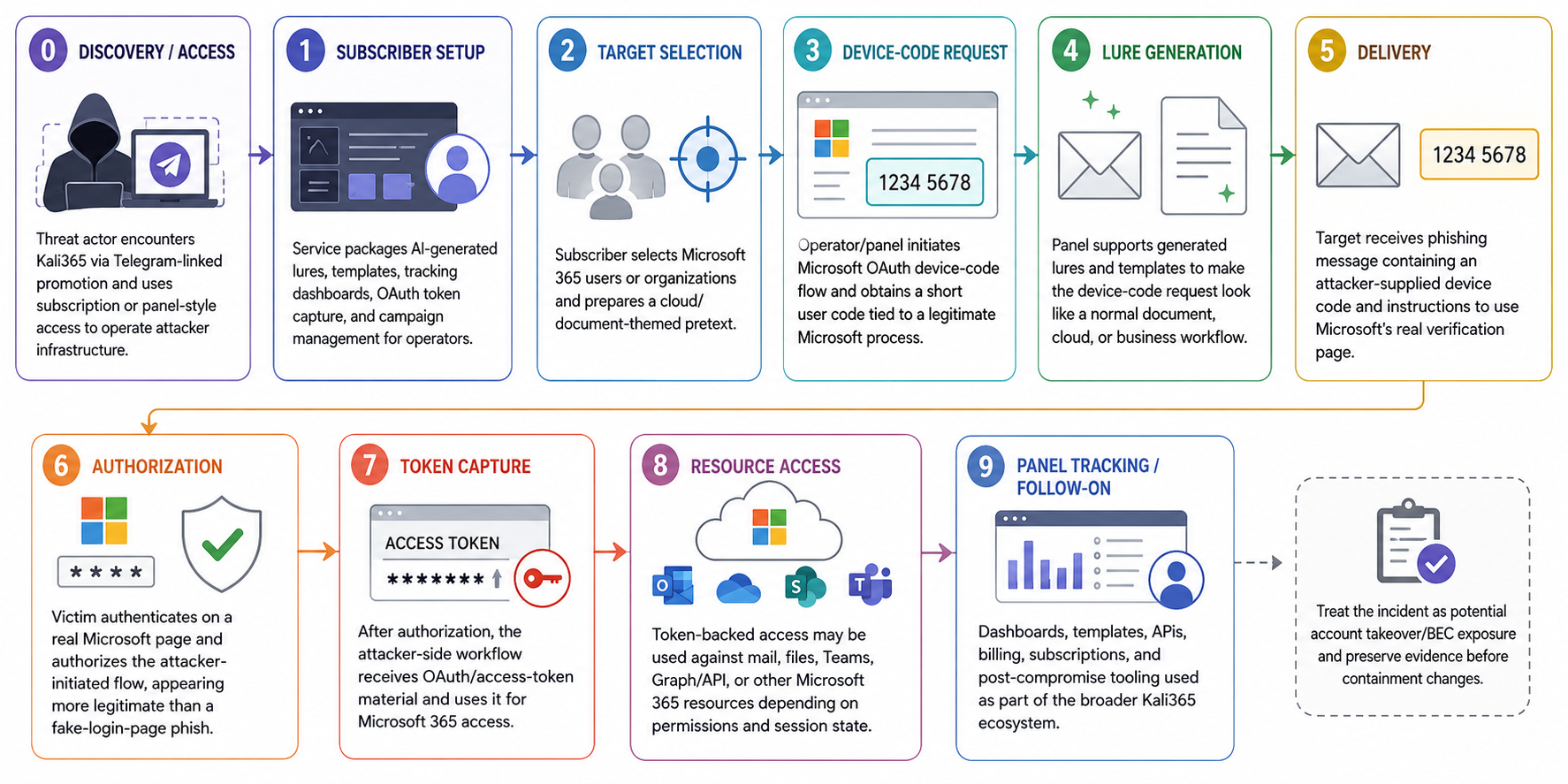
| Step | Reported Tool / Operator Activity | What Defenders / Scopers Should Ask |
|---|---|---|
| 0. Discovery / Access | Public reporting indicates a threat actor can encounter Kali365 through Telegram-linked promotion and then use subscription or panel-style access to operate attacker-facing infrastructure. This page does not provide acquisition instructions. 1, 4, 16, 17 | Ask whether any internal investigation has found Telegram, marketplace, panel, or infrastructure references, but do not publish handles or acquisition paths. |
| 1. Subscriber Setup | The service is described as packaging AI-generated lures, templates, tracking dashboards, OAuth token capture, and campaign management for lower-skill operators. 1, 4, 15, 16, 17 | Frame Kali365 as a rented service ecosystem, not necessarily a single actor or one intrusion campaign. |
| 2. Target Selection | A subscriber selects Microsoft 365 users or organizations and prepares a cloud/document-themed pretext. | Collect target list context from the client: affected users, roles, mailboxes, executives, finance teams, administrators, or exposed shared mailboxes. |
| 3. Device-Code Request | The threat actor or rented Kali365 panel initiates a fresh legitimate OAuth 2.0 device-code request to Microsoft's /devicecode endpoint and obtains a short user code plus backend device code tied to Microsoft's real verification process. 5, 18 | Hunt Entra ID for device-code or device-authorization events around the user-report timeline. |
| 4. Lure Generation | The panelized workflow reportedly supports generated lures and templates that can make the device-code request look like a normal document, cloud, or business workflow. 1, 4, 15 | Preserve the email or message, headers, screenshots, link text, code, sender, recipient, and delivery time. |
| 5. Delivery | The target receives a phishing message containing an attacker-supplied device code and instructions to use Microsoft's real verification page. | Ask whether the user entered the code, whether MFA was completed, and exactly when the interaction occurred; device codes are short-lived, so timing matters. |
| 6. Authorization | The victim may authenticate on a real Microsoft page and authorize the attacker-initiated flow, making the event look more legitimate than a fake-login-page phish. 1, 5, 18 | Review sign-in logs, authentication-flow evidence, client/application identifiers, user context, and conditional access outcomes. |
| 7. Token Capture | The attacker-side workflow polls Microsoft's OAuth 2.0 /token endpoint with the backend device code; after victim authorization, it can receive OAuth access/refresh-token material for Microsoft 365 access. 1, 5, 18 | Revoke suspicious sessions/tokens, inspect refresh behavior, and do not rely on password reset alone. |
| 8. Resource Access | Token-backed access may be used against mail, files, Teams, Graph/API, or other Microsoft 365 resources depending on permissions and session state. | Scope Exchange, SharePoint, OneDrive, Teams, Graph/API, mailbox rules, forwarding, downloads, deletions, and suspicious outbound messages. |
| 9. Panel Tracking / Follow-On | Expansion research describes dashboards, templates, API endpoints, billing or subscription functions, and post-compromise tooling as part of the broader Kali365 ecosystem. 15, 16, 17 | Treat the incident as potential account takeover/BEC exposure and preserve evidence before containment changes. |
| OAuth 2.0 Element | Legitimate Flow | Kali365-Style Abuse / Defensive Meaning |
|---|---|---|
| Requesting device / client | A real device or app asks Microsoft for a code so a user can authorize it. | The “device” can be an attacker-controlled software client, backend, or panel session. The victim is not authorizing the attacker’s physical laptop; they are authorizing the attacker-controlled client/session. |
/devicecode | Microsoft returns a short user code, backend device code, verification URL, and expiration window. | The panel supplies the short user code and real Microsoft verification URL to the victim in a lure. The code is fresh and legitimate, not guessed or reused. |
| Microsoft verification page | The user enters the code on Microsoft’s real page and completes normal sign-in and MFA. | The page can be legitimate while the authorization context is attacker-controlled. “Real Microsoft page” does not equal “safe request.” |
/token | The requesting client polls Microsoft until the user authorizes or the request expires. | After authorization, Microsoft returns OAuth access/refresh-token material to the requester. Responders should revoke sessions/tokens and review OAuth grants, not stop at password reset. |
9-Term Glossary
| Term | Meaning In This Snapshot | Why It Matters |
|---|---|---|
| PhaaS | Phishing-as-a-Service: a criminal service model that packages phishing infrastructure, templates, dashboards, delivery support, or automation for other operators. | Frames Kali365 as a service ecosystem, not only a single phishing email. |
| Device-code flow | A legitimate OAuth flow where a user enters a short code on a verification page so a requesting device or client can receive tokens. 5 | The legitimate flow is what Kali365-style activity abuses. |
| OAuth token | An access artifact issued after authorization that can allow Microsoft 365 API, mailbox, file, or app access depending on scopes and session state. | Explains why password reset alone may not contain the event. |
| Refresh token | A token used to obtain new access tokens without re-entering the password during an active session or policy-valid state. | Supports longer-lived account access if not revoked. |
| AiTM | Adversary-in-the-middle phishing that proxies authentication and can steal session material. | Useful adjacent comparison, but not identical to device-code abuse. |
| Conditional Access authentication flows | Microsoft controls that can govern authentication-flow behavior, including device-code flow conditions. 6 | Relevant prevention and reauthentication control surface. |
10-TTPs
| TTP | MITRE | Tactic | Detail |
|---|---|---|---|
| Phishing lure with device-code instructions | T1566 | Initial Access | Cloud/document-themed lure gives the victim an attacker-supplied code and sends them to a legitimate Microsoft verification page. 1, 3, 11 |
| OAuth/access-token capture | T1528 | Credential Access | The attacker seeks Microsoft 365 token/session access rather than only a password. 1, 2, 12 |
| Valid account/session use | T1078 | Initial Access / Persistence | Post-authorization access may resemble ordinary user activity unless correlated with token, app, and resource-access telemetry. 1, 14 |
13-IOCs / Observables
This section is limited to field identification and hunting leads for Kali365-style device-code abuse. The key question is whether an unsolicited lure led a user into a Microsoft device-code authorization flow, followed by suspicious OAuth token, session, consent, or Microsoft 365 resource activity.
How To Identify This Attack
- User reports an unsolicited code, document-sharing lure, or instruction to visit a Microsoft verification page.
- Entra ID shows device-code or unusual authentication-flow activity around the user report.
- Unexpected OAuth consent, enterprise app, delegated permission, or refresh-token/session behavior appears.
- Mailbox, SharePoint, OneDrive, Teams, or Graph/API activity follows the suspected authorization event.
Primary Evidence To Preserve
- User report, lure text, screenshots, message headers, and delivery timeline.
- Entra sign-in logs, authentication-flow fields, token issuance, and risk events.
- Unified Audit Log, mailbox audit logs, app-consent history, and enterprise app changes.
| Artifact | What To Look For | Why It Matters |
|---|---|---|
| User report | Unexpected code, urgent document/cloud lure, or request to visit Microsoft verification page. | Establishes exposure and timing before logs are cleaned up. |
| Entra ID sign-in logs | Device-code / device-authorization flow, unusual client/app, unfamiliar location, high-risk user activity. | Primary identity evidence for Kali365-style abuse. |
| Token and session state | Access/refresh token issuance, unusual refresh behavior, active sessions that persist after the user report. | Password reset alone may not evict active token/session access. |
| OAuth consent / enterprise app | Unexpected app consent grants, new enterprise apps, unusual scopes, delegated permissions. | Confirms whether authorization created durable access paths. |
| M365 resource access | Exchange, SharePoint, OneDrive, Teams, Graph/API access following suspicious authorization. | Separates account exposure from confirmed data or business impact. |
Containment Control Effectiveness
| Action | Effect Against Device-Code / Kali365-Style | Effect Against AiTM / Reverse-Proxy | Operational Note |
|---|---|---|---|
| Password reset | Low. The attacker may not have stolen the password; token or session material can remain valid. | Low to medium. Useful if credentials were captured, but stolen sessions may remain active. | Do not stop here. |
| Revoke active sessions/tokens | High. Directly targets the OAuth/session artifact used for continued access. | High. Helps invalidate stolen session material and force renewed authentication. | Priority action. |
| Sign out everywhere / force reauthentication | High. Forces the user and suspicious sessions through fresh policy evaluation. | High. Reduces the window for reused stolen sessions. | Pair with review. |
| Revoke suspicious OAuth consents and app grants | High where consent/grant artifacts exist. | High where app grants or delegated access were abused. | Collect evidence first. |
| Conditional Access + phishing-resistant MFA | High as prevention and reauthentication control. | High, especially against replayable MFA and session-theft paths. | Tune by tenant. |
14-Threat Actor Glossary
| Name / Label | Classification | How To Use The Label | Boundary |
|---|---|---|---|
| Kali365 | PhaaS platform / tool ecosystem | Use when discussing the source-backed service model, device-code/OAuth abuse path, AI lures, templates, dashboards, and Microsoft 365 token-access risk. 1, 4, 15, 16, 17 | Not a confirmed single actor group. |
| Kali365 operators / subscribers | Criminal users of the service | Use for the likely users running campaigns from or around the platform. | Public sources do not identify a definitive customer list. |
| Device-code phishing operators | Technique-based grouping | Use when evidence supports OAuth device-code abuse but not the Kali365 brand specifically. 1, 2, 5, 18 | Do not over-attribute tenant logs to Kali365. |
| Kali Linux | Unrelated legitimate Linux distribution | Use only to avoid brand confusion; no retained source establishes affiliation with Kali365. 1, 23 | Not a threat actor label here. |
17-Exploitable Technology Risks
| Risk Area | Why It Is Exploitable | Control / Scoping Priority |
|---|---|---|
| Device-code authorization | Attackers can initiate a legitimate device-code flow and pressure a user to enter the supplied code on Microsoft's real verification page. 1, 5, 18 | Review authentication-flow policy, risky sign-ins, user reports, and device-code events. |
| OAuth consent and app grants | Unexpected delegated permissions or enterprise app grants can create durable cloud-access paths beyond a simple password. | Audit consent grants, enterprise apps, delegated permissions, and admin-consent workflow settings. |
| Token and session persistence | Token/session artifacts can remain useful after a password reset unless sessions and suspicious grants are revoked. 1, 6, 12, 18 | Revoke sessions/tokens, sign out affected users, force reauthentication, and scope post-authentication access. |
| Microsoft 365 workload access | Mailbox, file, Teams, SharePoint, OneDrive, and Graph/API activity can follow authorization and may look like normal user activity. | Correlate Entra ID, Unified Audit Log, Exchange, SharePoint, OneDrive, Teams, and Graph/API evidence. |
16-Decision Ready Actions
| Priority | Response Action | Likely Owner | Evidence Boundary |
|---|---|---|---|
| 1 | Preserve user reports, phishing messages, screenshots, headers, and identity logs before cleanup. | SOC / IR | Needed to distinguish exposure, authorization, access, and impact. |
| 2 | Review Entra ID sign-ins for device-code flow, token issuance, unusual clients, high-risk users, and unexpected OAuth consent. | IAM / SOC | Core evidence for Kali365-style abuse. |
| 3 | Revoke suspicious sessions/tokens, remove unauthorized OAuth grants, sign out affected users, and force reauthentication. A password reset can be part of cleanup, but it is not reliable containment by itself. 1, 5, 6, 12, 14, 18, 22 | IAM | Containment requires invalidating access artifacts, not only passwords. |
| 4 | Scope Exchange, SharePoint, OneDrive, Teams, and Graph/API access after the suspicious authorization. | IR / M365 Admin | Confirms or refutes mailbox/file/data access and BEC/fraud risk. |
| 5 | Tune Conditional Access authentication-flow controls and user consent governance: block or challenge device-code flows from untrusted locations, require phishing-resistant MFA for sensitive users, and limit device-code use to justified clients or compliant devices where feasible. | IAM / Security Engineering | Microsoft documents authentication-flow controls relevant to device-code risk. 6 |
12-CVE / Vulnerability References
| Question | Snapshot Answer | How To Use It |
|---|---|---|
| Is Kali365 a CVE? | No. Kali365 is a reported PhaaS/tool ecosystem and Microsoft 365 identity-abuse workflow, not a software vulnerability identifier. | Avoid presenting this as a patch-management issue. |
| Is device-code authorization vulnerable? | The OAuth device-code flow is legitimate Microsoft identity-platform functionality. The risk here is attacker misuse of a real authorization flow, not proof that Microsoft's documented flow is itself a CVE. 5, 6 | Focus on policy, detection, consent, token/session revocation, and user training. |
| Is there a KEV entry? | No KEV-listed vulnerability is part of this snapshot’s source-backed Kali365 finding. | Do not use CISA KEV status as the primary triage filter for this identity threat. |
22-Real World Examples
| Example / Finding | What Public Sources Support | Victim / Company Boundary | Scoping Value |
|---|---|---|---|
| Kali365 in the wild | IC3 identifies Kali365 as an emerging Microsoft 365 PhaaS first observed in April 2026, distributed primarily through Telegram, and capable of OAuth token capture, MFA bypass, persistent Microsoft 365 access, AI-generated lures, templates, and dashboards. 1 | No named victim companies are published in the source set used for this snapshot. | Treat the exposed population as Microsoft 365 users and organizations until local telemetry proves impact. |
| Real device-code abuse | Arctic Wolf and expansion research support real-world device-code phishing outcomes: token capture, mailbox access, malicious inbox rules, and post-authentication abuse patterns that defenders can hunt in Microsoft 365 telemetry. 2, 15, 17, 18 | Technique-level victimology does not equal a named Kali365 victim list. | Ask whether the user entered an unsolicited code, whether device-code authentication occurred, and what resources were accessed afterward. |
| Kali365 operating ecosystem | Expansion research describes panelized infrastructure, lure templates, API endpoints, billing, domain/infrastructure functions, and post-compromise tooling, making Kali365 look like a managed criminal service rather than a one-off lure. 15, 16, 17 | Do not publish seller handles, acquisition steps, panel URLs, or unverified victim identities. | Use this to explain why a low-skill operator may still generate polished lures and persistent access. |
| Known unknowns | Public sources used here do not provide a validated Kali365 customer list, confirmed operator identity, full victim list, reusable IOCs, OAuth client IDs, or a complete campaign count. | Absence of public names is not proof that no victims exist. | Local logs, affected-user interviews, Microsoft 365 audit data, and vendor/law-enforcement coordination determine actual exposure. |
23-Public Victims / Disclosure Matrix
| Victim / Population | Confirmed? | Reported / Disclosed By | Boundary |
|---|---|---|---|
| Microsoft 365 users and organizations | Category-level exposure | IC3 and corroborating public reporting describe Kali365 as targeting Microsoft 365 accounts and organizations through device-code/OAuth abuse. 1, 2, 3, 4 | This is not a named victim list. |
| Any locally affected tenant | Requires local confirmation | Client telemetry, user interviews, Entra ID logs, app-consent records, and Microsoft 365 workload evidence. | Name only if the organization publicly self-discloses or authorizes disclosure. |
| Named public victim organizations | Not populated | No reliable retained source names a specific Kali365 victim organization in this snapshot. | Do not promote forum claims, screenshots, leaked credentials, or operator marketing into confirmed victim rows. |
24-KEV and CVE Details
| Field | Current Assessment | Action |
|---|---|---|
| CVE | No CVE is associated with the Kali365 platform finding in this static snapshot. | Do not route this as a patch-only issue. |
| CISA KEV | No KEV item drives this Kali365 assessment. | Use identity controls and cloud-account scoping instead of KEV triage. |
| Identity control plane | The relevant public documentation is Microsoft's OAuth device-code flow and Conditional Access authentication-flow guidance. 5, 6 | Review whether device-code flow is allowed and under what conditions. |
25-MITRE ATT&CK Lifecycle Mapping
| Lifecycle Phase | Kali365-Relevant Behavior | MITRE Mapping | Evidence To Seek |
|---|---|---|---|
| Delivery / Initial Access | Lure delivers an attacker-supplied Microsoft device code or instructions. 1, 3, 11 | T1566 | Message artifacts, headers, code, sender, target, delivery time. |
| Authorization | Victim enters code on a legitimate Microsoft verification page, authorizing the attacker-controlled requester. 1, 5, 18 | T1528 | Device-code sign-in, token issuance, app/client identifiers. |
| Access / Persistence | Token/session-backed Microsoft 365 activity may continue until sessions and grants are revoked. | T1078 | Session state, OAuth grants, mailbox/file/API activity. |
| Collection / Fraud Enablement | Mailbox, file, Teams, Graph/API, internal phishing, or BEC-style activity may follow. | Tenant-specific | Unified Audit Log, Exchange, SharePoint, OneDrive, Teams, Graph/API, outbound messages. |
11-Common Questions Q&A
| Common Question | Answer | Scoping / Defensive Use |
|---|---|---|
| If Microsoft device codes are short-lived, does the attack self-sabotage when a user waits hours or days? | Yes, stale codes can fail. That does not neutralize the attack model; it pushes operators toward urgency, repeated lures, automation, and real-time or near-real-time campaign workflows. Microsoft documents that device-code flow depends on polling, expiration, and token issuance after user authorization. 5, 18 | Ask when the user received the lure, when they entered the code, and whether any device-code sign-in or token issuance occurred during the valid window. |
| How can this work if the user only entered the code on a real Microsoft page? | The page can be legitimate while the authorization context is attacker-controlled. The attacker or panel generates a fresh legitimate Microsoft device-code request, supplies that user code to the victim, and receives token material if the victim completes sign-in and MFA for the attacker-initiated flow. 1, 5, 18 | Do not clear the incident just because the URL was Microsoft. Validate the code origin, device-code event, token/session state, and resource access. |
| Is a password reset enough? | No. A password reset can be part of cleanup, but it is not reliable containment when the attacker has token/session material or unauthorized OAuth grants. 1, 6, 12, 18 | Revoke sessions/tokens, remove suspicious OAuth grants, sign out affected users, force reauthentication, and scope post-authentication access. |
| Can we tell from logs that an event was specifically Kali365? | Usually not from basic tenant logs alone. Logs can support device-code phishing, token issuance, consent, session, and Microsoft 365 access patterns; attribution to Kali365 requires source-backed artifacts, panel/infrastructure evidence, or trusted third-party validation. | Classify the incident by mechanism first. Avoid naming Kali365 unless the evidence supports the platform label. |
| Are named Kali365 victim companies public? | No named victim organizations are published in this snapshot’s source set. The supported victimology is category-level: Microsoft 365 users and organizations. 1, 2, 15, 17 | Use local telemetry, client interviews, validated lookup/notification channels, and law-enforcement or vendor notices for victim-specific conclusions. |
| Is Kali365 connected to Kali Linux? | No source used here establishes an affiliation between Kali365 and Kali Linux or Offensive Security. Treat the shared word “Kali” as a naming collision unless an authoritative source says otherwise. 1, 23 | Avoid brand confusion in client-facing language. |
| Is this a ransomware threat? | Kali365 is best framed as Microsoft 365 account-takeover, BEC-adjacent, and cloud-data-exposure risk. Ransomware is a downstream possibility only if local telemetry shows broader intrusion or deployment activity. | Separate lure exposure, authorization, cloud access, data exposure, fraud, and broader intrusion into distinct findings. |
Expansion Research Add
15-Talking Points
| Technical Audience | Talking Point | Evidence / Action Focus |
|---|---|---|
| SOC / Detection | Treat unsolicited device-code prompts as potential account-access events, not just phishing noise. The decisive evidence is the chain from lure report to device-code sign-in, token/session activity, OAuth consent, and Microsoft 365 resource access. | Correlate user reports, Entra ID sign-ins, audit logs, Exchange, SharePoint, OneDrive, Teams, and Graph/API activity. |
| IAM / Entra Admins | The control question is whether device-code authentication is needed in the tenant and, if so, which users, clients, locations, and risk states should be allowed. Microsoft documents Conditional Access controls for authentication flows. 6 | Review Conditional Access authentication-flow policies, user consent settings, admin consent workflows, high-risk accounts, and token/session revocation procedures. |
| M365 Admins | A successful device-code abuse event may look like legitimate cloud activity after authorization. Do not stop at sign-in review; scope mailbox, file, Teams, and API activity after the suspicious event. | Check mailbox access, inbox/forwarding rules, SharePoint/OneDrive downloads or sharing, Teams/internal messaging, and Graph/API access. |
| IR / DFIR | Preserve evidence before containment changes. Password reset alone is not reliable containment if token, session, or OAuth grant artifacts remain valid. 1, 6, 12, 18 | Export relevant sign-in, audit, consent, session, mailbox, file, and user-report evidence; then revoke sessions/tokens and unauthorized grants. |
| Threat Intel | Classify by mechanism before brand. Device-code/OAuth abuse, AiTM/session theft, and classic credential-harvesting PhaaS create different telemetry and should not be collapsed into one bucket. | Use Kali365 for device-code/OAuth PhaaS context; compare EvilProxy/Tycoon-style activity as AiTM/session-interception context only when supported. |
| Scopers / Counsel Support | Separate exposure stages: lure received, code entered, authorization completed, token/session issued, Microsoft 365 resource accessed, data or fraud impact confirmed. | Build the timeline from user interview, message artifacts, Entra logs, app consent, token/session records, and workload logs. |
Expansion Research Add
21-About the Contributors
| Contributor | Who They Are / What They Do | Contribution & Why It Matters Here | Sources |
|---|---|---|---|
| FBI / IC3 | U.S. cybercrime public-warning and complaint center. | Primary public-warning authority for Kali365, first-observed timing, Microsoft 365 OAuth token-capture framing, Telegram distribution, AI lures, dashboards, and MFA-bypass risk. | 1 |
| Microsoft | Microsoft 365 and Entra identity platform owner. | Explains the legitimate OAuth device-code flow and Conditional Access authentication-flow controls that defenders need to understand and govern this attack path. | 5, 6 |
| Arctic Wolf | Security operations and incident-response provider. | Practitioner reporting that adds real-world device-code phishing impact patterns, including token capture, mailbox access, malicious inbox rules, and Microsoft 365 account-takeover implications. | 2 |
| Bitdefender / BleepingComputer | Security vendor and independent cybersecurity news outlet. | Corroborate the IC3 warning and translate the Kali365 service model, subscription-style tooling, AI lures, templates, dashboards, and device-code mechanics for broad security audiences. | 3, 4 |
| Huntress / Todyl / SpyCloud / cside | Threat research, MDR, cyber intelligence, and web security organizations. | Expansion research on Kali365 panelized infrastructure, templates, API endpoints, billing/subscription functions, domain or lure infrastructure, observed authentication activity, and post-compromise tooling. | 15, 16, 17, 18 |
| MITRE ATT&CK / Kali Linux Project | Industry behavior framework and official Kali Linux project source. | MITRE provides common language for phishing, token theft, and valid-account behavior. Kali Linux is included only to clarify there is no sourced affiliation between Kali365 and the legitimate Kali Linux distribution. | 11, 12, 14, 23 |
26-Source Weighting / Relevance
| Source Group | Contribution To This Snapshot | Confidence | Caveat |
|---|---|---|---|
| Official / Authoritative | IC3 establishes the Kali365 warning, first-observed timing, Microsoft 365 OAuth/token-capture framing, Telegram distribution, AI lures, templates, dashboards, and MFA-bypass risk. Microsoft explains the legitimate device-code flow and Conditional Access control plane. 1, 5, 6 | High | Official sources do not provide a full marketplace map, named victim list, complete panel inventory, or reusable IOCs. |
| Vendor / Practitioner | Arctic Wolf, Bitdefender, Huntress, Todyl, SpyCloud, and cside add campaign observations, feature context, panel/infrastructure descriptions, victimology boundaries, and Kali365-specific defensive context. 2, 4, 15, 16, 17, 18 | Medium-High | Separate observed telemetry and source-backed analysis from operator marketing claims, affiliate claims, and unverified pricing or scale statements. |
| Security Media | BleepingComputer corroborates and translates the FBI/IC3 warning for broad security audiences. 3 | Medium | Useful for awareness and corroboration, but secondary to official and practitioner sources for technical detail. |
| Framework / Definitions | MITRE ATT&CK supplies behavior mapping for phishing, token theft, and valid-account use. Kali Linux Project documentation is used only to prevent name-confusion with Kali365. 11, 12, 14, 23 | High for definitions | Frameworks and name-confusion sources do not prove Kali365 operations or campaign attribution. |
| Expansion Research | Expansion sources describe live panels, panel variants, API endpoints, templates, billing or subscription features, domain or lure infrastructure, and observed authentication activity. This is sufficient to discuss platform behavior and operational design. 15, 16, 17, 18 | Medium-High | This is not the same as a complete public source-code review, full operator identification, or permission to publish acquisition details. |
19-Tier 0 Through Tier 8 Source Summary
| Tier | Trust Role | What It Supports | Caveat |
|---|---|---|---|
| Tier 0 - Most Trusted | Industry framework / highest-confidence reference | MITRE ATT&CK mappings for phishing, token theft, and valid-account behavior. 11, 12, 14 | Technique definitions and behavior vocabulary, not incident proof. |
| Tier 1 - Authoritative | Official advisory and platform documentation | IC3 Kali365 warning, Microsoft device-code/OAuth documentation, Conditional Access authentication-flow guidance, and Kali Linux name-confusion clarification. 1, 5, 6, 23 | Official docs explain the warning and control plane; local tenant telemetry proves whether it happened. |
| Tier 2 - High-Value Research | Vendor and practitioner research | Arctic Wolf and Bitdefender add operational context around device-code phishing impact, Kali365 service features, and Microsoft 365 account-takeover implications. 2, 4 | Use for technical and operational enrichment while keeping IC3 as the controlling advisory source. |
| Tier 3 - Corroborating News | Security media corroboration | BleepingComputer corroborates the IC3 warning and translates the mechanism for broad security audiences. 3 | Secondary to official and practitioner sources for technical findings. |
| Tier 4 - Community Signal | Social/community discovery | No promoted social/community signal source was retained for this static snapshot. | Telegram distribution is treated as source-backed distribution context, not as a community-signal citation. |
| Tier 5 - Custom Source (defined by user) | User-provided source set | No user-defined custom source was added to this static snapshot. | Add only when a user supplies a source for this product. |
| Tier 6 - Custom Integrations with API/Keys | API-backed discovery | Placeholder for future X/API or other keyed discovery checks. | No API-derived source is promoted in this static snapshot. |
| Tier 7 - Inner Discovery / Carved URLs | Links discovered inside retained sources | No carved-url source is independently promoted in this static snapshot. | Carved URLs should remain lead-only until retained, read, and source-weighted. |
| Tier 8 - Expansion Research | Additional public research | Huntress, Todyl, SpyCloud, cside, Proofpoint, and eSentire add panel/infrastructure context, device-code lineage, account-takeover tradecraft, and defensive nuance. 15, 16, 17, 18, 19, 20, 21, 22 | Adds insight without proving named victims, full operator identity, complete source-code review, or acquisition details. |
20-Source Reconciliation
| Question / Tension | PANDA Resolution | Why It Matters | Sources |
|---|---|---|---|
| Core source agreement | The source set consistently frames Kali365 as Microsoft 365-focused PhaaS tied to OAuth/device-code abuse, token-oriented access, Telegram-linked distribution, and lower-friction campaign operation. | Gives high confidence in the basic tool profile even where operator identity and victim details remain unknown. | 1, 3, 4, 15, 16, 17, 18 |
| Similarity across sources | Official, vendor, media, and expansion sources all describe Kali365 as a service ecosystem rather than a one-off phishing email. | Supports treating the page as an actor/tool/campaign snapshot instead of a simple phishing-lure note. | 1, 4, 15, 16, 17 |
| Tool vs actor vs campaign | Treat Kali365 as a PhaaS platform/tool ecosystem used by multiple criminal customers, not as a single named intrusion set or one campaign. | Prevents false attribution and keeps scoping focused on mechanism, access, and telemetry. | 1, 15, 16, 17 |
| Kali365 vs Kali Linux | No source used here establishes any affiliation between Kali365 and Kali Linux or Offensive Security. | Avoids brand/name confusion from the shared word 'Kali.' | 1, 23 |
| Fake-login phishing vs device-code abuse | Kali365 should be framed around device-code/OAuth authorization abuse where the victim may interact with Microsoft's real verification page. | Explains why password-only assumptions and fake-domain hunting are incomplete. | 1, 5, 18 |
| Device-code vs AiTM telemetry | Device-code attacks may show legitimate Microsoft authorization and token/session behavior; AiTM and reverse-proxy attacks more often add proxy, IP, impossible-travel, client, or session-cookie reuse clues. | Prevents analysts from hunting for only the wrong artifact family. | 1, 5, 18, 19, 22 |
| Victim names and impact | Public sources support Microsoft 365 users and organizations as the exposed population, but do not provide publishable named Kali365 victim companies in this snapshot. | Keeps the brief useful without inventing victimology. | 1, 2, 15, 17 |
| Indicators vs behavioral observables | No stable public Kali365 blocklist is published here; use device-code events, token/session behavior, OAuth consent, and M365 resource access as hunt leads. | Prevents false confidence from missing domains, IPs, hashes, or client IDs. | 1, 5, 6, 18 |
| Password reset as containment | Password reset alone is insufficient; responders must revoke sessions/tokens, remove suspicious OAuth grants, sign out affected users, force reauthentication, and scope resource access. | Targets the actual access artifact instead of only the password. | 1, 6, 12, 18 |
27-Additional IntelliOS Threat Intel Products on This Topic
Companion Flash Brief
Kali365 Microsoft 365 OAuth Device-Code PhaaS Brief
Executive-ready Flash Threat Intel Brief comparing Kali365 device-code token abuse against peer PhaaS mechanisms and identity-response priorities.
How To Use Both
Use the Flash Brief for quick briefing and stakeholder awareness. Use this Snapshot when teams need Kali365-specific tool profile, forensic scoping, and containment depth.
28-Notes
Create an account and sign-in to use this card.
Record your personal notes and comments in this card related to this brief.
29-Version Change Log
| Version | Date | Change | Basis |
|---|---|---|---|
| v1.0 | 21-Jun-2026 | Initial Kali365 Campaign, Tool or Actor Snapshot with source-weighted profile, device-code/OAuth scoping guidance, and response priorities. | Baseline publication |
| Layout standardization | 28-Jun-2026 | Aligned the page to the FortiBleed reader standard: 32-card menu model, 12-card default view, 3 default-expanded cards, drawer card settings, no-crop banner rendering, and citation-to-citations-card behavior. | Template update |
30-Citations
News Sources Answering The Topic Question
| # | Source | Published | Why Used |
|---|---|---|---|
| 1 | FBI / IC3: Kali365 Phishing-as-a-Service Public Service Announcement | May 21, 2026 | Tier 1. Authoritative public warning for Kali365, Microsoft 365 OAuth token capture, device-code lure path, Telegram distribution, AI-generated lures, dashboards, and MFA-bypass framing. |
| 2 | Arctic Wolf: Token Bingo: Don't Let Your Code be the Winner | April 24, 2026 | Tier 2. Practitioner reporting on large-scale device-code phishing, token capture, mailbox access, malicious inbox rules, and Microsoft 365 account-takeover implications. |
| 3 | BleepingComputer: FBI warns of Kali365 phishing service targeting Microsoft 365 accounts | May 25, 2026 | Tier 3. Corroborates the IC3 warning and translates device-code phishing mechanics for a broad security audience. |
| 4 | Bitdefender: FBI warns of Kali365 phishing kit that breaks into Microsoft 365 accounts | May 22, 2026 | Tier 2. Vendor reporting on subscription model, AI lures, templates, dashboards, and reduced operator skill barrier. |
| 5 | Microsoft Learn: OAuth 2.0 device authorization grant - Microsoft identity platform | Living documentation | Tier 1. Official Microsoft documentation explaining the legitimate OAuth 2.0 device-code flow, including the /devicecode request, verification URL, user code, device code, /token polling, expiration, and token issuance. |
| 6 | Microsoft Learn: Conditional Access: Authentication flows | Living documentation | Tier 1. Official Microsoft guidance describing authentication-flow controls, including device-code flow risk and Conditional Access policy options. |
| 11 | MITRE ATT&CK: T1566 - Phishing | Living framework | Tier 0. Industry-standard technique definition for phishing delivery and social-engineering lures. |
| 12 | MITRE ATT&CK: T1528 - Steal Application Access Token | Living framework | Tier 0. Industry-standard technique definition for stealing application access tokens, central to OAuth-token abuse. |
| 14 | MITRE ATT&CK: T1078 - Valid Accounts | Living framework | Tier 0. Industry-standard technique definition for valid-account abuse after tokens, cookies, or credentials are obtained. |
Expansion Research
| # | Source | Published | Why Used |
|---|---|---|---|
| 15 | Huntress: Inside Kali365, a Device Code Phishing Ecosystem | June 2026 | Tier 8. Expansion research describing observed device-code activity, panel variants, lure templates, API endpoints, RBAC, billing, domain marketplace, and post-compromise tooling. |
| 16 | Todyl: Kali365 PhaaS: Inside the Attack Infrastructure | June 2026 | Tier 8. Expansion research describing a live Kali365 operator panel, subscription access, payment claims, and attacker-facing infrastructure observations. |
| 17 | SpyCloud: Kali365: Anatomy of a Microsoft 365 Phishing-as-a-Service Kit | June 2026 | Tier 8. Expansion research on Kali365 victimology, affiliate claims, operator rebranding, device-code capabilities, and why password resets alone may be insufficient. |
| 18 | cside: MFA Didn't Fail, the Trust Model Did: Device Code Phishing and OAuth Token Theft (Kali365) | June 5, 2026 | Tier 8. Expansion research explaining device-code phishing, OAuth token theft, trust-model abuse, and detection implications for Kali365-style attacks. |
| 19 | Proofpoint: Access Granted: Phishing With Device Code Authorization for Account Takeover | December 2025 | Tier 8. Expansion research on device-code phishing as an account-takeover pattern, used here to distinguish the broader technique from Kali365 as a named PhaaS implementation. |
| 20 | eSentire: Tycoon 2FA Operators Adopt OAuth Device Code Phishing | May 12, 2026 | Tier 8. Expansion research showing device-code phishing adoption outside Kali365, useful as adjacent context for PhaaS-supported Microsoft 365 account takeover. |
| 21 | Proofpoint: Device Code Phishing is an Evolution in Identity Takeover | May 2026 | Tier 8. Expansion research framing device-code phishing as part of the evolution of identity takeover, not as a technique invented by Kali365. |
| 22 | Proofpoint: Evolving Threat: Microsoft AiTM Phishing Attacks | 2025 | Tier 8. Expansion research on Microsoft 365 adversary-in-the-middle phishing and session-focused account takeover, used only as adjacent BEC/M365 ATO context. |
| 23 | Kali Linux: Kali Linux Official Site | Living project site | Tier 1. Official Kali Linux project source used only to clarify that Kali Linux is a separate penetration-testing Linux distribution and is not established as affiliated with Kali365 in the sources used here. |